 +86-573-85605006
 zhouyueliang@L-jie.com
A buyer approves a 12-can cooler bag from a photo and a spec sheet. The first bulk shipment arrives, and the 500 ml containers that fit the sample no longer sit flat; the zipper strains at the corners. Width and height were correct. Depth had been measured across the gusset while the bag was empty, and the production version used a thicker foam panel. Depth is the dimension most often misread, and it is the one that decides whether a bag closes comfortably under load.
Treat bag depth as a fit dimension, not a line on a drawing. Confirm where it is measured, whether it is internal or external, and how much of it disappears when the bag is packed.
Content
Depth is the front-to-back distance of the bag body, measured perpendicular to the width, with the bag closed and the side panels flattened. It is not the widest bulge of a stuffed bag, and it is not the spread of the gusset at the seam. For a cooler bag, depth controls how many containers sit in a row and whether an ice pack can lie flat on top. For a laptop backpack, depth controls whether the device compartment and the main load compete for the same space.
Three versions of depth matter in purchasing:
| Depth is the only dimension that changes shape when a soft bag is packed; record it both empty and loaded. | ||
| Dimension | Measured from | What it tells you |
| Height | Base to the top of the body, with handles excluded unless stated | Vertical fit for bottles, laptops, and stacked containers |
| Width | Left to right at the widest stable point | Horizontal fit and the number of items per row |
| Depth | Front to back at the base, bag closed and panels flat | Bulk, capacity, and whether the zip closes without strain |
| Drop | Top of the bag to the highest carry point | Shoulder and hand clearance |
| Linear size | Height plus width plus depth | Totals used by carriers and size-check boxes |
Use a rigid ruler or a caliper, not a soft tape, for the depth itself. A soft tape follows the curve of the bag and adds a centimetre or two without anyone noticing. Follow the same sequence every time so that sample measurements and production checks are comparable.
State the tolerance in the tech pack. A sewn soft bag commonly carries plus or minus 0.5 cm on depth, while a foam-lined cooler may move by 3 to 5 percent depending on panel thickness and compression during packing. The important point is not the exact number; it is whether the tolerance applies to the external or the internal measurement.
Capacity is the product of three dimensions, so depth errors compound quickly. On a 30 by 20 cm footprint, a 3 cm depth error changes volume by 1.8 litres, roughly the difference between a lunch bag for one person and one for two. That is why a bag can match its stated width and height and still fail the practical test.
Laptop fit is a common example. A 16-inch laptop is about 35.8 cm wide and 24.7 cm deep. A protective case needs an internal depth of roughly 2.5 to 3 cm, plus foam clearance, before the device can slide in without forcing the zip. If the same compartment shares depth with a main pocket, the loaded main pocket can press against the laptop and reduce the usable space.
Cooler bags have a similar constraint. A 12-can load with a flat ice pack usually needs 14 to 16 cm of internal depth to sit in two rows without crushing the contents. A structured hard cooler cannot borrow depth from fabric stretch, so the internal figure must be fixed at the design stage.
Depth also affects travel sizing. Many carriers assess a bag by a linear total of height, width, and depth. A bag that sits at the limit in two dimensions has no room to gain depth, even if the extra centimetre would make packing much easier. Measure the loaded bag, not the empty one, before comparing it with a size-check frame.
A soft-sided bag rarely delivers its nominal depth under load. A tote or backpack listed at 15 cm may give 12 to 13 cm of usable depth once the base is filled, because the side panels bow outward and the zip line pulls inward. Overloading can push the depth past the stated figure and distort the shape, which is a quality complaint even when the bag still closes.
Structured coolers and foam-lined cases hold their depth better, but they are less forgiving of a design error. A hard cooler with a fixed internal depth of 24 cm either accepts the containers or it does not; there is no fabric give to absorb a mistake. The trade-off is predictable packing in exchange for tighter measurement discipline.
 LJ23-CB003-24L Hard Cooler with Removable Inner BucketA 24L hard cooler with removable inner bucket and wipeable lining, suited to buyers comparing fixed-depth coolers and checking external versus internal depth.View Product →
Insulation adds another variable. A thicker foam panel improves thermal performance but reduces internal depth, so the external size can stay the same while the usable space shrinks. Buyers comparing insulation bag advantages should ask for both external and internal depth on the same drawing.
Depth requirements follow the load, not the product name. The ranges below are practical starting points for sampling, not fixed standards; a specific container or device should always be measured before a mould or pattern is approved.
| Use these ranges as a starting point for sampling, then confirm with the actual load and a loaded measurement. | ||
| Use case | Typical internal depth | Reason |
| Laptop sleeve or case | 3 to 5 cm | Device thickness plus foam and zip clearance |
| Commuting laptop backpack | 12 to 18 cm main body | Separate device compartment plus daily carry items |
| Insulated lunch bag | 12 to 16 cm | Containers in one or two rows with a small ice pack |
| Backpack cooler for day hikes | 15 to 20 cm | Bottles, food, and ice pack without side bulge |
| Folding shopping bag | 10 to 15 cm | Flat-packed groceries and a stable base |
| Children's backpack | 10 to 14 cm | Books and a lunch box without tipping the load |
A laptop backpack illustrates the compromise well. Too little depth and the device compartment presses on the main load; too much and the bag becomes bulky on a commute. The useful approach is to define the device size, the daily load, and the acceptable bulge in that order, then set the depth.
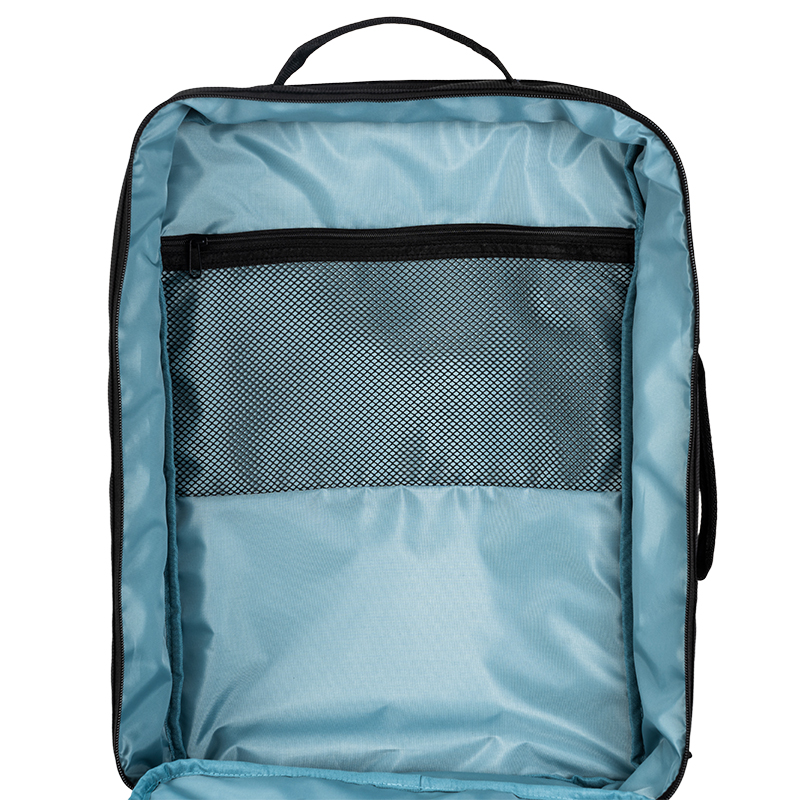 LJ23-003 15.6-Inch Laptop Travel BackpackA durable Oxford backpack with padded 15.6-inch laptop compartment and multiple organizer pockets, relevant when balancing device protection, daily load, and commute bulk.View Product →
Depth is easy to measure and easy to misstate. Put the measurement protocol in the tech pack: where depth is taken, whether it is internal or external, the load used for the loaded measurement, and the acceptable tolerance. Ask for three sample measurements at the base, mid-height, and top, both empty and loaded. A supplier who can provide that data before production is usually the one who understands where depth is lost.
Specific questions worth asking:
For an insulated tote, the answers often decide whether the bag is sold as a 15 cm or a 12 cm product, even though the outside looks identical. Adjustable or collapsible designs can blur the figure further, so the loaded measurement should be the one printed on the specification.
 LJ23-CB005 Adjustable Insulated Tote with Large CapacityA large insulated tote with adjustable strap and PEVA lining, useful for checking loaded depth and capacity before specifying a fixed size.View Product →
If the depth is borderline for the intended load, change the pattern before production rather than relying on fabric stretch. A 1 cm change at the sampling stage is inexpensive; a 1 cm shortfall across a bulk order is a returns problem.
Depth is not a decorative number on a product page. It is the dimension that governs how a bag carries, closes, and survives a real load. If you are developing a cooler bag, laptop backpack, or shopping tote and need the internal depth verified against your contents, send the measurements to our team and we will match them to a pattern before sampling.
1. Understanding Shopping Bags Shopping bags are essential tools in modern retail and daily life. They serve as a convenient way to carry groceries, c...
View More1. Introduction In our increasingly mobile and digital world, the laptop has become the central hub of our professional and personal lives. It connect...
View MoreLearn how to choose the perfect crossbody water bottle sling bag — sizing, materials, wearing styles, packing checklist, top features to prioritize, a...
View MoreAn innovative enterprise that continuously strives to have its own brand through its own efforts. bag production factory
Phone: +86-13906735273
Tel: +86-573-85605006
Email: zhouyueliang@L-jie.com
Email: sunny@L-jie.com
Add: No.99 Xinchen Road. Xindai, Pinghu, Zhejiang, China
Copyright© 2025 Pinghu Liangjie suitcase & bag Co., Ltd. All Rights Reserved.
 Custom Luggage Bags Manufacturers


 English
 Français
 Español
 Deutsch
 عربى