 +86-573-85605006
 zhouyueliang@L-jie.com
A buyer issues a purchase order for a tote bag at 40 x 30 x 15 cm. The factory ships exactly those numbers. Weeks later, the retail team discovers the bag will not hold an A4 folder standing upright, because the 30 cm was taken to the top of the seam rather than the top of the opening. Nothing was manufactured incorrectly. Both sides simply used different definitions for the same three figures.
That is the everyday reality of bag measurements: the numbers matter less than the convention behind them. Decide first where width starts and stops, whether depth includes the gusset seam, and how much the fabric relaxes when loaded. Do that before quoting, and samples, bulk orders and retail listings line up. Skip it, and every centimetre becomes a negotiation.
Content
Almost every bag specification is built on three figures, usually written as W x H x D. They look simple until two people measure the same sample and get different results.
Two extra conventions prevent most disputes. First, state whether the bag is measured empty and relaxed or filled to a representative load. Second, state whether the measurement includes seams and binding. A 12 mm binding allowance on each side quietly removes 24 mm from the usable internal width.
The process below is the one worth writing into a specification sheet, because it produces repeatable results on a workbench in any factory or buying office.
For soft bags, repeat steps 2 to 4 with the bag filled to a typical load. A 15 cm depth measured empty can read 18 cm when packed, and that difference decides whether a bottle or a lunch box fits.
A 12 L hard cooler and a 12 L insulated tote can carry very different amounts, because insulation thickness sits inside the external shell. A cooler with 20 mm foam walls on all six faces loses several litres of cavity to material that protects the contents but holds no food. The same logic applies to padded laptop compartments, structured bases and reinforced end panels.
| Term | What it describes | What to confirm with the factory |
|---|---|---|
| External width, height, depth | The outside envelope of the bag body | Whether seams, binding and side pockets are included |
| Internal cavity | The clear space available for contents | Measurement taken after lining and insulation are fitted |
| Gusset depth | How far the base opens front to back | The value at both ends, and the larger of the two |
| Handle drop | Clearance between the handle top and the bag opening | Measured on a loaded bag, not an empty one |
| Usable volume | Practical capacity in litres | Calculated from internal dimensions, not external ones |
 LJ23-CB002-12L Oxford Cloth Hard Cooler12 L hard cooler with Oxford cloth shell and wipeable lining; compare its listed external dimensions and internal cavity before choosing for outdoor meals.View Product →
Rigid coolers make the point clearly: the outside dimensions describe shipping and shelf space, while the internal cavity decides whether a 1.5 L bottle stands upright or has to lie down.
Two bags with identical bodies can feel completely different to carry. Handle drop is measured from the top of the handle loop down to the bag opening, taken with the bag under load. A drop of around 10 cm suits hand carrying, 20 to 25 cm clears a shoulder, and 45 cm or more is needed to sit over a winter coat.
For adjustable straps, list the minimum and maximum length plus the width in millimetres. A 38 mm webbing strap spreads weight noticeably better than a 25 mm one, and padded strap thickness affects both comfort and how the bag hangs against the back. On backpacks, record the back panel length from the shoulder strap attachment to the base, since that figure, not the litre count, decides whether the bag suits a shorter or taller wearer.
Internal height is the figure that matters most here. A lunch bag with a 22 cm internal height takes a standard food container upright; at 18 cm the same container has to tilt. Check the depth of the front pocket separately, because an ice pack stored outside the insulated cavity warms faster. Where a bag is described as double-layer or large capacity, ask for the cavity dimensions per compartment rather than a single overall figure.
 LJ25-CB002 Double-Layer Insulated Lunch BagDouble-layer insulated lunch bag with separate hot and cold compartments; its 24 x 16.5 x 21 cm size helps check whether containers fit upright.View Product →
A sleeve rated for a 15.6 inch laptop needs roughly 1 to 2 cm of clearance over the device on each axis, otherwise the zip closure presses on the chassis corners. Ask for the padded compartment dimensions with the padding in place, plus the thickness of the drop protection at the base. If the bag will also be used as cabin luggage, check the external dimensions against airline limits before signing off the sample. Our guide to choosing a backpack covers how compartment layout interacts with daily carry.
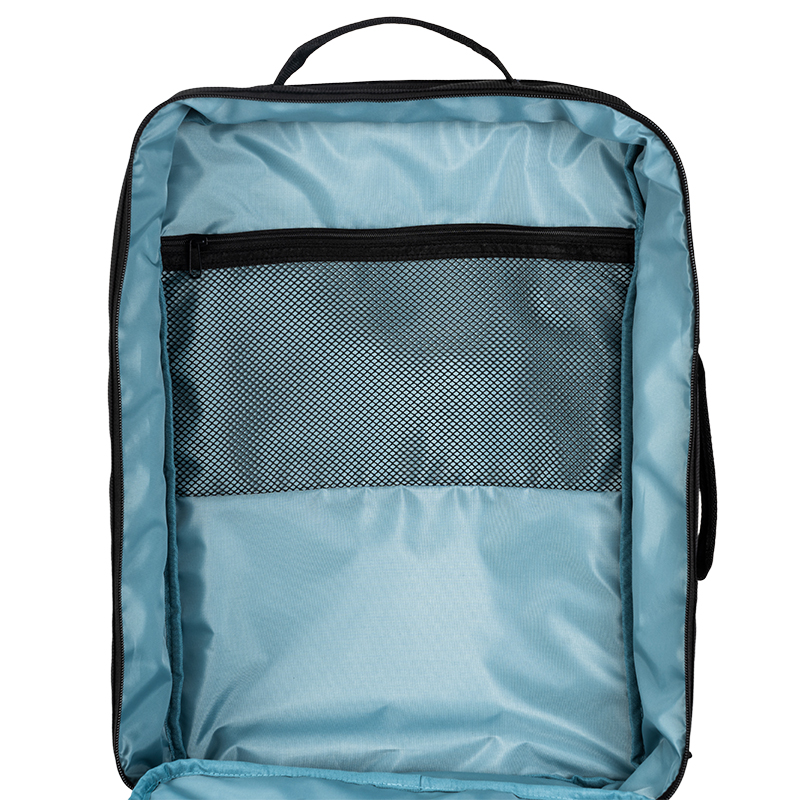 LJ23-003 Multi-Purpose Travel Laptop BackpackTravel backpack with padded 15.6-inch laptop compartment and listed 29.5 x 12 x 43 cm dimensions, useful for checking device clearance and daily organization.View Product →
For flat totes, list both the flat width and the filled width, because a non-woven or oxford tote spreads considerably once loaded. Folding bags need a third figure that rarely appears on a spec sheet: the folded size, since that determines whether the bag fits a glovebox or a retail display pocket. For backpacks, capacity in litres should always be paired with the internal cavity dimensions, as two 20 L packs can differ by several centimetres in usable height.
Soft bags rarely hold a dimension to the millimetre. A working tolerance of plus or minus 1 cm on soft-sided bodies, and plus or minus 0.5 cm on moulded or hard-shell products, is realistic and should be written into the order rather than argued about at inspection. Rounding matters too: converting 15.75 inches to 40 cm and back again loses a few millimetres that a laptop compartment cannot spare.
Whether you are comparing stock bags or commissioning a custom run, a short measurement block resolves most of the risk. Include external width, height and depth with the measurement convention noted; internal cavity dimensions for each compartment; gusset depth at both ends; handle drop and strap range; weight in grams; tolerance per dimension; and the units used throughout.
Getting these figures settled early is a small amount of paperwork that saves a great deal of rework. If you are working on a cooler bag, backpack or shopping bag programme and want the dimensions verified against your target market, send the specification to our team through the contact page and we can advise on realistic tolerances and construction allowances.
1. Understanding Shopping Bags Shopping bags are essential tools in modern retail and daily life. They serve as a convenient way to carry groceries, c...
View More1. Introduction In our increasingly mobile and digital world, the laptop has become the central hub of our professional and personal lives. It connect...
View MoreLearn how to choose the perfect crossbody water bottle sling bag — sizing, materials, wearing styles, packing checklist, top features to prioritize, a...
View MoreAn innovative enterprise that continuously strives to have its own brand through its own efforts. bag production factory
Phone: +86-13906735273
Tel: +86-573-85605006
Email: zhouyueliang@L-jie.com
Email: sunny@L-jie.com
Add: No.99 Xinchen Road. Xindai, Pinghu, Zhejiang, China
Copyright© 2025 Pinghu Liangjie suitcase & bag Co., Ltd. All Rights Reserved.
 Custom Luggage Bags Manufacturers


 English
 Français
 Español
 Deutsch
 عربى