 +86-573-85605006
 zhouyueliang@L-jie.com
A plain canvas tote bag is one of the most democratic creative surfaces available. It costs little, takes most decoration methods well, and turns a functional carry-all into something unmistakably personal. Small wonder that decorated totes have become one of the strongest expressions of the broader personalization trend reshaping accessories in 2026 — with the global tote bags market valued at over USD 2.3 billion and projected to grow steadily through the next decade, driven by customization demand and sustainability preferences.
Whether you are decorating one bag as a personal project, producing a small run for a pop-up stall, or briefing a manufacturer on branded merchandise, the fundamentals are the same: choose the right technique for your material, execute the design with the right tools, and finish it in a way that survives repeated use and washing. This guide covers all three.
Content
Three converging forces are behind the decorated tote bag's rise. The first is sustainability: as single-use plastic bag bans expand across Europe, North America, and Asia, reusable totes have gone from niche to necessity. People now carry them daily — which means they want one that reflects their personality, not a forgettable branded giveaway from a conference.
The second is social media visibility. A tote bag is one of the few accessories that faces outward in public spaces, commuter trains, and coffee queues. A strong design gets noticed. Platforms like Instagram and TikTok have amplified this effect, turning distinctive hand-painted or embroidered totes into shared content and, occasionally, sold-out products.
The third is the maker economy. The accessibility of tools like Cricut cutting machines, heat presses, and digital embroidery files has lowered the barrier for small-batch custom production to the point where decorating totes at home and selling them online is a credible side business for thousands of crafters. The result is a culture where both DIY decoration and custom-order purchasing are normalized, and demand for interesting blank bags — the starting material for all of it — continues to grow.
Not every decoration technique works on every bag. Getting this pairing right before you start saves wasted materials and disappointing results.
Canvas and cotton are the most forgiving surfaces for decoration. They absorb fabric paint readily, accept heat transfer vinyl with excellent adhesion, and provide a stable weave for hand embroidery. Screen printing ink bonds to natural fibres better than to synthetics, making canvas the standard choice for print runs. If you are starting out and want maximum compatibility, canvas and cotton tote bags built for everyday use and customization are the reliable baseline.
Lightweight recycled or woven polypropylene bags are common in promotional and grocery contexts. They accept screen printing and some iron-on transfers, but their synthetic surface can resist fabric paint and embroidery unless specially treated. For detailed custom printing on these materials, digital heat transfer via a polyurethane film transfer gives the most consistent result. Lightweight eco-friendly reusable tote bags that take decoration well strike a balance between print-ready surfaces and sustainable credentials.
Oxford cloth and polyester blends work best with sublimation printing (which requires a minimum polyester content of around 65%) and digital heat transfers. They are less suited to hand painting or tie-dye, as the dye does not bond as reliably to synthetic fibres without specialist pre-treatment.
Jute and burlap have an open, textured weave that creates a rustic aesthetic but limits fine detail. Block printing, stamping with fabric ink, and iron-on patches work well on jute. Intricate HTV designs or detailed screen prints tend to lose definition on the uneven surface.
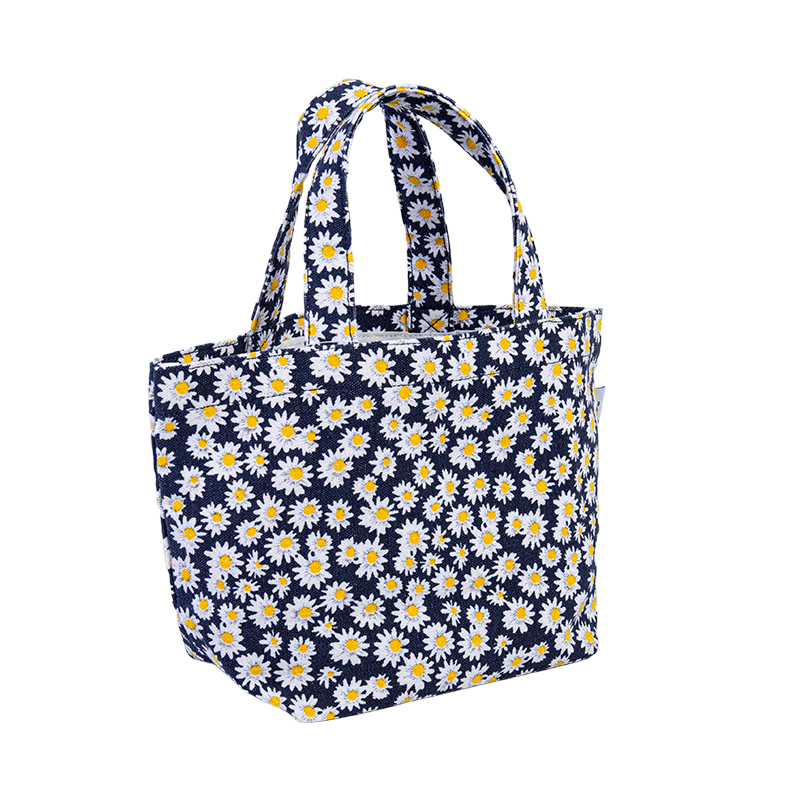
The table below maps each technique to its difficulty level, best-suited bag material, and ideal use case — from one-off personal projects to small commercial runs.
| Technique | Difficulty | Best Material | Best For |
|---|---|---|---|
| Fabric Paint / Hand Painting | Beginner | Canvas, cotton | One-of-a-kind art pieces, freehand designs |
| Fabric Markers | Beginner | Canvas, cotton | Lettering, illustration, line-art designs |
| Iron-On Transfers & Patches | Beginner | Canvas, cotton, denim | Photo prints, logos, decorative accents without sewing |
| Tie-Dye | Beginner–Intermediate | 100% cotton | All-over colour effects, party and event activities |
| Heat Transfer Vinyl (HTV) | Intermediate | Canvas, cotton, poly-cotton blends | Bold text, logos, repeat designs; small-batch commercial |
| Embroidery | Intermediate–Advanced | Canvas, cotton, denim | Monograms, florals, premium handcrafted look |
| Screen Printing | Advanced | Canvas, cotton, natural fibres | Bulk runs with consistent multi-colour designs |
Fabric paint is the most accessible entry point. Squeeze bottle or brush application, no specialist equipment required. Slide a piece of cardboard inside the bag before painting to prevent bleed-through. Heat-set the finished design by ironing the reverse side at a cotton setting once the paint is fully dry — typically 24 hours — to lock colour and improve wash resistance.
Heat Transfer Vinyl (HTV) delivers a clean, professional finish ideal for text-heavy designs, logos, and geometric shapes. Cut your design from coloured vinyl using a Cricut or Silhouette machine (remember to mirror the design before cutting), weed away the excess, and press onto the bag at 305–320°F for 10–15 seconds with firm pressure. Multiple vinyl colours can be layered for multi-colour designs. Foldable shopping bags as a versatile blank canvas for print decoration are a particularly practical choice for HTV projects — their flat panels give ample working area for bold graphic designs.
Iron-on transfers are ideal when you want to reproduce a photograph or complex multicolour artwork without a cutting machine. Print the mirrored image onto printable transfer paper using an inkjet printer, position it face-down on the bag, and press at the recommended temperature. Since the ink bonds into the fabric rather than sitting on top of it, this method tends to be more resistant to peeling than HTV over time.
Embroidery adds tactile depth that no printed method can replicate. Even a simple satin-stitch monogram or outline floral motif transforms a plain bag into something that reads as premium. Hoop the bag panel to keep tension even, use an embroidery needle with a sharp tip for canvas, and back the finished work with a piece of felt to protect the threads from snagging inside the bag.
Tie-dye works exclusively on 100% cotton. Pre-soak the bag in soda ash solution to open the fibres, twist or fold into your chosen pattern, secure with rubber bands, apply fibre-reactive dye, and leave to cure in a sealed bag for 6–24 hours before rinsing. The results are reliably vibrant and no two bags come out the same — which is either a feature or a limitation, depending on the project.
Technique is only half the equation. Knowing what to put on the bag — and how to compose it — determines whether the finished piece is something people actually want to carry.
Botanical and nature motifs remain the most consistently popular design direction for hand-painted and embroidered totes. Monstera leaves, wildflower clusters, mushrooms, and coastal motifs (shells, waves, coral) translate beautifully into both painterly and line-drawn styles. The organic irregularity of hand-painted botanicals means no two bags are identical, which drives perceived value.
Statement typography is the dominant choice for HTV and screen-printed designs. Short, declarative phrases — a book quote, a city name, a personal motto — rendered in a strong typeface and high contrast colour make for immediately readable, highly shareable bags. Serif typefaces have regained ground over sans-serifs in 2025–2026, giving typographic totes a slightly editorial, literary feel.
Maximalist colour-blocking is trending in response to the years of quiet, neutral-toned minimalism that preceded it. Bold geometric shapes in high-contrast colour combinations — think cobalt and terracotta, olive and burnt orange — applied in fabric paint or as large HTV shapes, read as deliberately contemporary. These designs work particularly well on natural-coloured canvas where the base material adds warmth.
Photo and illustration transfers appeal to anyone who wants a genuinely personal bag — a favourite artwork, a pet portrait, a film still. Heat transfer paper makes reproducing a high-resolution image surprisingly straightforward at home, though image quality on fabric depends heavily on using a high-resolution source file and a light-coloured bag base. For a custom exterior that pairs well with a practical interior, insulated tote bags that combine function with custom exterior designs offer a more versatile decorated carry solution for picnics, beach trips, and farmer's market runs.
Minimalist line drawings suit fabric markers and single-colour screen prints. A single continuous-line face, a simplified architectural landmark, or a small constellation drawn directly onto unbleached canvas has a deliberately understated quality that reads as both casual and considered. Less technically demanding than detailed illustration, but highly effective when the design concept is strong.
The gap between a beautiful decorated tote and a faded, cracked, or peeling one usually comes down to two moments: the finishing step immediately after decoration, and the first wash.
Heat-setting is non-negotiable for fabric paint. Skipping it leaves pigment that sits on the surface rather than bonding to the fibres, and the first wash strips a significant portion of the design. Iron over the painted area (using a piece of parchment paper or a cloth as a barrier) at a cotton setting for 3–5 minutes once the paint has cured for at least 24 hours. Some fabric paints specify oven-curing at 160°C for 5 minutes as an alternative — check the manufacturer's instructions.
Wait before the first wash. For both fabric paint and HTV, allow at least 72 hours after decoration before laundering. Washing too soon, before adhesives and pigments have fully cured, is the most common cause of premature design failure.
Wash inside out, cold, gentle cycle. Turn the bag inside out to protect the decorated surface from friction against the drum. Cold water reduces pigment bleed and prevents HTV from lifting at the edges. Avoid tumble drying if possible — air drying significantly extends the life of any decoration. This applies equally to iron-on transfers, embroidery, and painted designs.
Choose quality materials from the start. Cheap fabric paint brands often sacrifice pigment density and binder quality for price. Similarly, lower-grade HTV peels faster and resists fewer washes than quality vinyl. Investing marginally more in materials at the outset pays back many washes later — especially important if the decorated bag is a gift, a product for sale, or a brand item expected to represent quality through repeated use.
A decorated tote bag earns its place precisely because it combines utility with identity. Executed well, the design becomes more associated with the person carrying it over time — not less. That longevity, both material and emotional, is what separates a thoughtfully decorated tote from one that lasts a season and disappears.
1. Understanding Shopping Bags Shopping bags are essential tools in modern retail and daily life. They serve as a convenient way to carry groceries, c...
View More1. Introduction In our increasingly mobile and digital world, the laptop has become the central hub of our professional and personal lives. It connect...
View MoreLearn how to choose the perfect crossbody water bottle sling bag — sizing, materials, wearing styles, packing checklist, top features to prioritize, a...
View MoreAn innovative enterprise that continuously strives to have its own brand through its own efforts. bag production factory
Phone: +86-13906735273
Tel: +86-573-85605006
Email: zhouyueliang@L-jie.com
Email: sunny@L-jie.com
Add: No.99 Xinchen Road. Xindai, Pinghu, Zhejiang, China
Copyright© 2025 Pinghu Liangjie suitcase & bag Co., Ltd. All Rights Reserved.
 Custom Luggage Bags Manufacturers


 English
 Français
 Español
 Deutsch
 عربى
عربى