 +86-573-85605006
 zhouyueliang@L-jie.com
The Big Backpack Meme: Where It Started
If you have spent any time on social media in the past few years, you have encountered the big backpack meme in one form or another — a person staggering under an absurdly oversized pack, a first-day-of-school student carrying what appears to be a small satellite dish strapped to their back, or a traveler whose luggage has clearly won the power struggle with their body. The image lands because it captures something immediately recognizable: the particular human tendency to prepare for every possible scenario by bringing everything.
One of the most viral iterations traces back to a Gucci backpack image that circulated widely on X (formerly Twitter) from 2019 onward, famously captioned with the suggestion to "just let it go" — a line that became a standalone meme reaction format across Reddit, Instagram, and TikTok. As NewsBreak's breakdown of the Just Let It Go Bruh backpack meme notes, the image showed a bag whose straps were barely clinging on — a visual metaphor that resonated far beyond the original post. The broader category of big backpack content on TikTok has accumulated hundreds of millions of views across variants: school hallway clips, airport security fails, oversized pack pranks, and the reliably funny "new Year 7 students on their first day" genre that appears every September without fail.
The meme has staying power because it is rooted in a genuine cultural experience — one shared by students, travelers, commuters, and anyone who has ever tried to be fully prepared and slightly overshot the mark.
Content
The comedy of the big backpack meme works on multiple levels simultaneously. At the surface level, it is visual absurdity — a human being apparently overpowered by their own bag. But beneath the humor sits a more universal truth that the internet recognized instantly: most of us carry more than we need, metaphorically and literally, and the oversized backpack is simply the most photogenic version of that condition.
For students, the big backpack is a rite of passage. The first day of a new school year arrives with a maximum level of preparedness — every notebook, every textbook, every pencil case, the lunch bag, the water bottle, the emergency snack, the gym kit — all consolidated into a single bag that towers above its owner. By mid-term, most of that cargo has been sensibly redistributed or abandoned, but the opening-day commitment to total readiness is both universal and reliably funny to everyone who has ever lived it.
For travelers, the meme captures the anxiety that drives overpacking: the fear that wherever you are going, you will need something you did not bring. The solution — bring everything — produces the meme-worthy result of a backpack that could plausibly shelter a small family. For commuters and remote workers, the laptop, the chargers, the emergency cables, the snacks, the gym clothes, the change of shoes — it all adds up to a daily carry that qualifies as luggage by most airline standards.
The giant backpack meme resonates because it captures a universal feeling of carrying too much — whether academic pressure, job stress, or life's general weight — expressed through the lighthearted visual of an absurdly large bag. It invites laughter and reflection simultaneously, which is why it keeps getting remade and reshared across every platform where people are looking for something to recognize themselves in.
Here is the thing the meme does not tell you: sometimes a big backpack is genuinely the correct answer. The humor works because overpacking is relatable — but underneath the joke is a real category of situations where a large-capacity backpack is not excessive, it is simply appropriate to the task.
The cases where a big backpack makes practical sense include:
The meme is about the ratio between capacity and actual need. When that ratio is roughly 10:1 — carrying a 50-liter pack for a two-hour errand — the humor is earned. When the carry genuinely requires the capacity, the big backpack stops being a punchline and starts being the right tool.
The real version of the big backpack problem is not capacity — it is organization. A 40-liter backpack with no internal structure quickly becomes a black hole where items disappear and retrieving anything requires unpacking the entire contents. The same bag with thoughtful packing becomes a system that holds everything accessible and intact.
The principles that separate meme-level overpacking from genuinely functional large-bag use:
Not all large backpacks are created equal. A bag that is simply large — with one cavernous compartment and basic straps — amplifies the problems of overpacking without solving any of them. A genuinely functional large backpack is engineered to make its volume usable rather than just available.
The features that distinguish a functional large backpack from a bag that merely has capacity:
The "right" large backpack looks different depending on who is carrying it and where. Three user profiles dominate the practical market for oversized packs, each with distinct requirements:
For travelers and commuters who need adult-sized capacity with professional construction, the adult backpacks for travel, commuting, and everyday use are built with wide padded shoulder straps, breathable back padding, and multi-functional loading capability across laptop, clothing, and gear compartments.
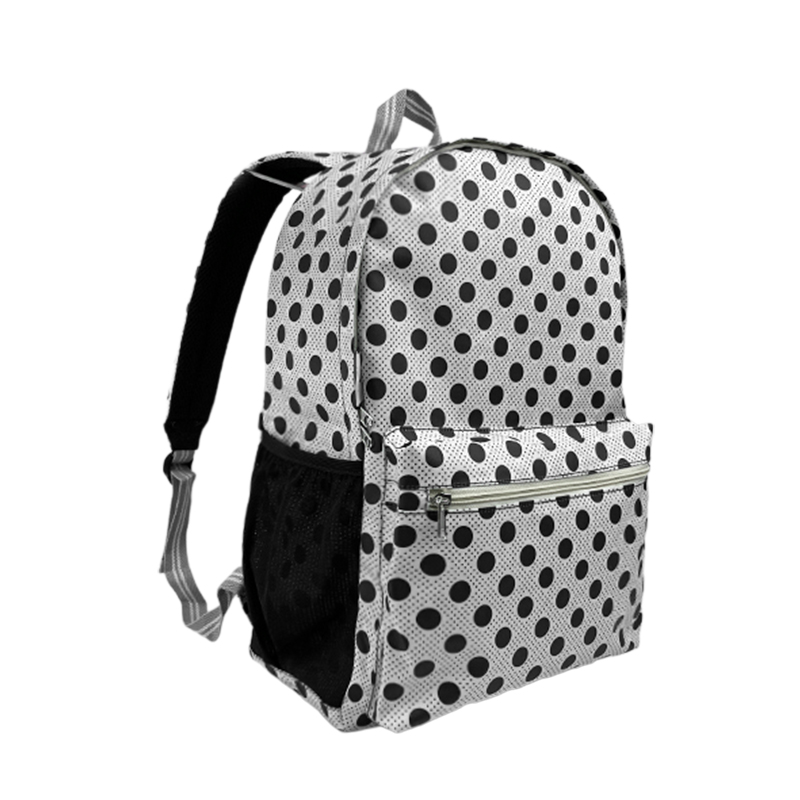
The children's version of the big backpack meme is perhaps the most recognizable subset: the Year 7 or first-day-of-school image of a child visibly struggling beneath a pack that appears to weigh more than they do. It is funny from a distance and genuinely concerning up close — because for children, the wrong backpack (or the right backpack badly loaded) creates real musculoskeletal risk over a school year of daily carry.
Pediatric health guidelines consistently recommend that a child's loaded backpack should not exceed 10–15% of their body weight. This is a threshold that is routinely exceeded by students carrying full textbook loads without locker access. The backpack itself cannot reduce that load — but it can significantly affect how that load is distributed and experienced. A children's backpack with a correctly sized and padded back panel, adjustable shoulder straps, and a waist or chest strap transfers weight more effectively and reduces the forward-leaning compensatory posture that causes long-term strain.
Size matters too — not just capacity, but fit. A backpack designed for adult proportions worn on a child-sized frame will sit too low (placing weight on the lumbar spine rather than the mid-back) and place the shoulder straps too far apart (creating outward pull on the shoulder joints). A children's-specific back panel length and narrower strap spacing make a genuine ergonomic difference, particularly for younger students in the 6–12 age range. For school-age children across different ages and carry requirements, the children's backpacks for school and daily use are designed to match smaller frames while providing the organizational structure needed for a full school day's load.
The meme version of the big backpack decision is: get the biggest one available and pack it with everything you own. The practical version is more nuanced. Five questions to answer before buying:
The big backpack meme endures because it captures a recognizable human truth. But the best version of the story — the one that does not end up as someone's viral video — is a well-chosen large backpack whose capacity is matched to a genuine carry need, packed thoughtfully, and built to last. For the full range of adult and travel-oriented options in large-capacity formats, the full backpack range for different needs covers everything from lightweight daily-carry to structured travel configurations.
1. Understanding Shopping Bags Shopping bags are essential tools in modern retail and daily life. They serve as a convenient way to carry groceries, c...
View More1. Introduction In our increasingly mobile and digital world, the laptop has become the central hub of our professional and personal lives. It connect...
View MoreLearn how to choose the perfect crossbody water bottle sling bag — sizing, materials, wearing styles, packing checklist, top features to prioritize, a...
View MoreAn innovative enterprise that continuously strives to have its own brand through its own efforts. bag production factory
Phone: +86-13906735273
Tel: +86-573-85605006
Email: zhouyueliang@L-jie.com
Email: sunny@L-jie.com
Add: No.99 Xinchen Road. Xindai, Pinghu, Zhejiang, China
Copyright© 2025 Pinghu Liangjie suitcase & bag Co., Ltd. All Rights Reserved.
 Custom Luggage Bags Manufacturers


 English
 Français
 Español
 Deutsch
 عربى
عربى